


The engagement crisis in online learning is no longer a rumble; it is a roar. Despite the impressive growth of digital education over the last fifteen years, completion rates for massive open online courses (MOOCs) typically range from 5% to 15%.
A widely cited study that included data from 221 MOOCs (massive open online courses) found that the percentage of enrolled learners who finish a course ranges from from 0.7% to 52.1%, with the typical (median) completion rate being just 12.6%.
Further, data from Harvard and MIT MOOCs show that the overall completion rate fell to 3.13% in the 2017‑18 academic year, down from nearly 6% in 2014‑15.
To gamify online learning, you can address this crisis directly.
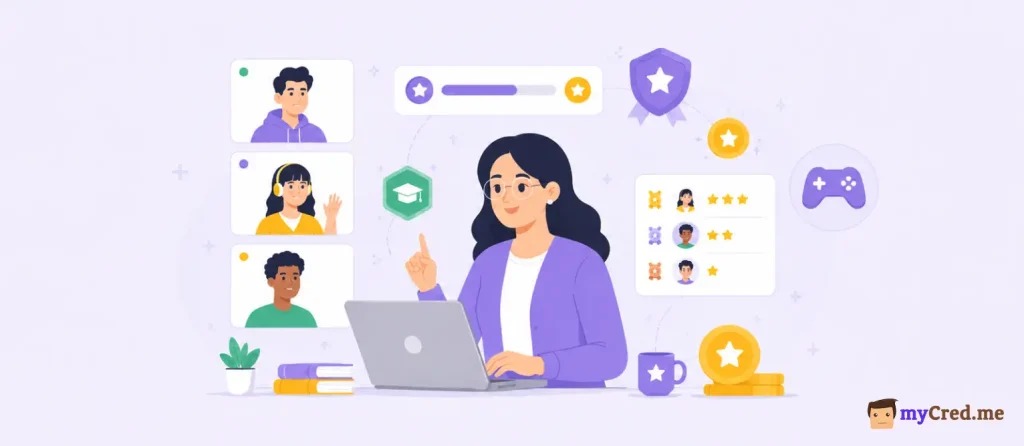
Gamification is the integration of game-like mechanics like points, badges, levels, and leaderboards into interactive environments and educational content to turn passive learning into engaging experiences.
The common misconception surrounding gamification is that it affects the seriousness of the learning process by introducing an “element of play”.
On the contrary, it recognizes achievements, rewards efforts, and motivates learners to keep moving forward through positive reinforcement.
The bridge between course content and sustained student motivation is myCred, a powerful gamification engine built for WordPress.
Unlike custom‑coded solutions that require developers, myCred offers a no‑code control panel that lets educators set up reward rules in minutes. It integrates natively with the most popular Learning Management Systems (LMS) on WordPress, including LearnDash, LifterLMS, Tutor LMS, and LearnPress.
This article explores how educators can gamify online learning with myCred to turn course completion into meaningful engagement in education.
What Is Online Training Gamification?
Online training gamification is the strategic use of game‑design elements in non‑game learning environments to achieve positive results. It is not about turning calculus into a fantasy role‑playing game. It is about using proven psychological mechanisms to make hard work feel rewarding.
Three core mechanisms power the concept of gamification.
- First: dopamine loops. When a learner completes a lesson and immediately sees a points notification, the brain releases dopamine. This small biochemical reward makes the learner more likely to repeat the action.
- Second: progress visibility. A progress bar that fills, a badge that appears, or a rank that changes provides clear evidence of forward movement. Humans are naturally motivated by visible completion.
- Third: the balance between intrinsic and extrinsic motivation. Intrinsic motivation comes from the joy of mastering a topic. Extrinsic motivation comes from external rewards like points or badges. Gamification uses extrinsic rewards as stepping stones to help learners build habits until the intrinsic value of the learning itself takes over.
Another common misconception is that gamification means turning courses into childish games. That is incorrect. Professional online training gamification respects the learner’s maturity. A corporate compliance course can use a clean ranking system (Trainee, Practitioner, Expert, etc.) and discrete badges for completed modules.
WordPress integrated with the right LMS stack is the ideal foundation for educators who want to implement gamification without incurring the cost of expensive custom development.
WordPress powers over 42% of all websites, and its ecosystem includes LMS plugins like LearnDash, LifterLMS, and Tutor LMS.
From solo educators to Fortune 500 companies and major universities, LearnDash is the trusted industry standard for professional course creators.
LifterLMS offers a strong free‑to‑start model with built‑in membership features. Tutor LMS is completely free and user‑friendly. These platforms integrate directly with myCred, allowing educators to gamify online learning on day one using native hooks for lessons, quizzes, and logins.
Why Educators Choose myCred for Education Engagement
Even though there are a few other gamification plugins available for WordPress, myCred is the only solution that addresses the real-world needs of teachers, trainers, and course creators.
No‑Code Reward System Setup
Most educators are not developers. They do not write PHP or debug database queries. myCred respects this reality. Its entire loyalty reward system operates through a visual, dashboard‑based interface.
An educator can define a hook (a trigger that awards points) for virtually any activity: completing a lesson, passing a quiz, logging in daily, or leaving a comment. There are no coding requirements. A school teacher, a corporate trainer, or a solo entrepreneur can launch a complete gamification strategy in an afternoon.
This accessibility is why myCred is often called the best gamification plugin for non‑programmers.
Native LMS Integrations to Gamify Online Learning
myCred’s power lies in its deep, native integrations with the leading WordPress LMS plugins. These are not generic workarounds but purpose-built add-ons by the myCred development team that understand LMS-specific events.
- myCred LearnDash: This integration allows educators to award points upon completion of specific courses, lessons, topics, or quizzes. Points can be awarded flexibly based on quiz scores. The LearnDash Points Importer (part of the myCred Addon) enables seamless migration from other points systems.
- myCred LifterLMS: Points can be awarded for completing a lesson, a section, a full course, or even deducted if a student fails an assessment. It also supports awarding points upon a student’s enrollment in a membership.
- myCred Tutor LMS: Administrators can distribute points for enrolling in or completing general or specific courses, lessons, or quizzes. This turns Tutor LMS into a powerful gamified teaching platform.
- myCred LearnPress: Students earn points for completing lessons, quizzes, assignments, and other course activities.
Education Engagement Metrics That Matter
To measure educational engagement, educators will require data. myCred provides educators with full logs containing details of every point earned and deducted. The educator can identify which students are earning points, which activities generate the most engagement, and areas of poor interaction. Some metrics that can be tracked includeof the metrics that can be tracked include: course completion, number of quizzes taken, speed of lesson completion, and daily login streaks.
Connecting Engagement to Tangible Outcomes
Points are more than just abstract numbers on a digital leaderboard. Thanks to the WooCommerce Plus add-on, students can trade their points for discounts on future classes, credits for purchasing merchandise, or even tangible products.
In some cases, points can also be used to unlock extra learning materials or gain early access to new course modules. This ensures an immediate, tangible reward for studying hard, increasing the likelihood that learners will return. In teachers’ experience, learner engagement skyrockets once they understand the tangible value of points.
These four advantages explain why myCred has become the standard for WordPress‑based education engagement. The next section will explore six practical tactics educators are using to put these capabilities into action.
How Educators Use myCred to Gamify Online Learning
The following list provides six techniques that can be implemented to gamify online learning using the myCred platform. These tactics target specific behavioral traits of learners and may impose restrictions, such as point limits, expiration, and notifications.
1. Badge Tiers for Module Completion (Bronze/Silver/Gold)
Badges are symbols of achievement that engage the brain’s reward mechanism. When the learner earns a badge on completing the module, the brain releases a little amount of dopamine – the neurotransmitter responsible for pleasure and reinforcement. This makes it likely for the learner to repeat the behavior.
With the help of the myCred Badge Editor, teachers create custom digital badges that are automatically issued on completion of modules or point accumulation. In a digital marketing course, one may earn badge titles: “Bronze Marketer” (upon completion of the first three courses), “Silver Marketer” (upon completion of the next five), and “Gold Marketer” (upon completion of the entire module).
Why it works: First, badges show a pathway to success. The learner knows what comes next, and each badge earned triggers a small dopamine release as a form of reinforcement. Secondly, the Badge Editor is included in myCred Core and guarantees compatibility with open‑badge standards. That means that badges are valid and shareable on any platform. Finally, with the Badge Editor, you may design an unlimited number of badges without the use of hooks or limits. Real‑time updating, thousands of icons, and exporting in SVG/PNG/JPG formats.
2. Bonus Points for Perfect Quiz Scores
Even though quizzes are assessment tools, they can also be powerful motivators. With myCred hooks for quizzes (integrated with LearnDash, LifterLMS, and Tutor LMS), teachers can reward extra points for achieving perfect quiz results. For instance, a weekly quiz could award 50 points for an 80% score, but 150 points for a perfect 100%.
The myCred LearnDash v2.0 extension, released in 2026, allows teachers to adjust points based on quiz results, such as passing a quiz at a specified maximum percentage or earning a specific percentage range.
Why it works: The pursuit of perfection becomes a game within the course. Students become more thorough in reviewing content, take quizzes on their own initiative more often, and achieve mastery through practice. If you introduce bonus marks for perfect results, students will voluntarily take quizzes to boost their scores and earn them. Teachers can impose attempt limits such as None/Daily/Weekly/Monthly.
3. Daily Login Streaks for Cohort‑Based Courses
Engagement is the strongest predictor of course completion. Studies show that dropout rates peak during the first 10 percent of module progression, underscoring the importance of early engagement.
myCred’s Daily Visits hook offers a series of points for logging into the system daily without breaks. These include 10 points on the first day, 20 points on the second day, 40 points on the third day, and so forth, with points being reset once you miss a day.
Why it works: The login streaks exploit the principle of loss aversion, the idea that losses hurt twice as much as equivalent gains. After earning a seven-day streak, losing one feels like a heavy blow, which motivates students to visit the website regularly. The hook is flexible, allowing instructors to customize the daily points limit and reset rules, while combining it with the Expiration Add-on would enable point decay for long-term inactivity.
4. Peer Recognition Points for Community Building
Online learning can be isolating. According to a case study on student engagement conducted by Evelyn Learning, more than two-thirds of students report feeling detached when learning online. Compared to face-to-face classroom settings, active participation numbers in an online environment drop by 45%, and student motivation falls by nearly 73%.
Why it works: Peer recognition taps into social motivation, which is distinct from instructor‑given rewards. The myCred Addon includes BP Group Leaderboards that automatically generate leaderboards based on user point balances, fostering team cohesion and friendly competition. The myCred Nominations add‑on enables users to nominate other members for new points and ranks, with nominations sent directly to the administrator for approval. This builds a culture of mutual support where learners celebrate each other’s achievements.
5. Unlock Bonus Content via Point Thresholds
Deeply engaged learners often finish the standard curriculum and want more. MyCred’s Content Protection feature allows educators to gate premium material behind a point balance. When a learner accumulates, say, 5,000 points, a new set of advanced lessons, case studies, or downloadable templates becomes available. The myCred Submissions add‑on further extends this by allowing learners to submit review forms to unlock badges, ranks, and other achievement‑based rewards.
Why it works: Learners who might otherwise disengage after completing required work now have a reason to stay. The Loyalty Dashboard shows learners their current balance and exactly how many more points they need to unlock each piece of content. Educators can also use the myCred Todo List add‑on to create checklists of everyday activities (e.g., “watch three video lectures,” “post one discussion comment”) that unlock badges or ranks upon completion, turning learning into a structured achievement system.
6. Leaderboards for Friendly Competition in Certification Prep
For high‑stakes certification courses, healthy competition can drive sustained effort. myCred’s Leaderboards display top point earners across a course or entire platform, updated in real time. Leaderboards tap into our natural desire for achievement and recognition, making training feel less like “work” and more like a progression through a series of achievements.
Why it works: When learners see they are just a few points away from the top spot, they are more likely to finish that next module to bridge the gap. Leaderboards transform solitary learning into an interactive challenge, fostering both individual and group competition.
In the myCred ecosystem, leaderboards can be filtered by time period (daily, weekly, all‑time) and by specific course, allowing focused competitions aligned with course milestones, such as a “Final Exam Prep Week” leaderboard. The Ranks feature integrates directly with leaderboards, rewarding users with significant perks upon reaching a milestone.
myCred’s modular, rule‑based architecture supports each of these six tactics. Educators can enable them individually, test their impact using myCred’s complete point logs, and scale what works. myCred now includes over 49 free add‑ons with seamless integrations for LearnDash, LifterLMS, Tutor LMS, and even form builders like WPForms. This modularity means educators never pay for features they don’t need, and only enable add‑ons to load, ensuring no negative impact on site performance.
The Real-World Impact When You Gamify Online Learning
When educators gamify online training, the impact extends far beyond surface‑level metrics. Here are some of the most common real‑world examples and impacts of gamification.
Shift From Passive Consumption to Active Participation
In traditional online courses, learners watch videos and move on. With myCred, each completed lesson, quiz attempt, and login earns points that feed into badges, ranks, and leaderboards. Learners become active participants, consciously seeking out rewarded behaviors.
Higher Course Completion Rates
Research published in Education and Information Technologies found that gamification led to “a 5.7% increase in the number of questions answered and a 1.6-percentage-point rise in completion rates” among 6,592 adult learners. A longitudinal STEM study reported a 14% higher success rate for gamified learning groups than for standard online learning, with average grades 25% higher. After implementing gamification, a Web 3.0 MOOC platform saw a 350% increase in course completions, a 400% increase in returning users, and a 300% increase in time spent on the platform.
Community Building Through Social Recognition.
Peer‑to‑peer point awards and team leaderboards shift the motivational focus from individual competition to group accomplishment and social recognition. This distinction is significant because, while individuals are driven by personal achievement, learners are often more motivated by their peers’ approval and recognition.
A LearnDash study found that gamification can increase conversion rates up to 8% by strengthening community bonds and learner loyalty. Learners celebrate each other’s badges and offer help more freely, knowing helpfulness is itself rewarded.
Point Logs as Engagement Analytics for Educators.
myCred maintains a complete, searchable log of every point award and deduction. Educators can see exactly when engagement spikes and where it drops. If a particular lesson earns few points, it may signal unclear content or an unrewarded behavior. This data turns gamification into a diagnostic tool.
Each time myCred gives or takes points from a user, the transaction is saved in the Logs section, recording details such as user identity, reference (e.g., “completed_lesson” or “perfect_quiz”), date, and point amount. The myCred Loyalty Dashboard further enhances this capability by consolidating essential loyalty metrics, customer engagement data, and performance analytics into a single, centralized hub. You can view overall data for all users or drill down into a specific user’s activity, tracking points earned or spent, awarding or deducting points, and managing badges and ranks – all from one interface.
Crucially, these results occur without making courses feel childish. Gamification that includes clean rank titles, understated badges, and optional leaderboards respects adult learners while still driving engagement.
Neuroscience research confirms that intrinsic motivation has three times greater impact on engagement than extrinsic motivators, so myCred’s system is designed to use points and badges as stepping stones that build toward genuine mastery, not meaningless tokens.
Tips for Educators to Gamify Online Learning
Launching a gamified learning environment requires strategy, not just technical setup. These tips will help you avoid common problems and maximize your return on investment.
- The biggest problem when implementing gamification is trying to reward everything: lesson completion, quiz scores, login streaks, posting comments, sharing content, etc. This results in point inflation (reward becomes meaningless), confusion, and administrative burden. Start by identifying the high-value behavior (such as completing a lesson) and build a points system around it.
- Balance extrinsic rewards with feedback. It is well established that if external rewards are merely superficial or meaningless tokens with no real-world relevance, learners will pay less attention to the actual content. Use myCred Email Notifications to set up notifications for students when they reach milestones (“Congratulations, you’ve earned Silver Scholar badge”) is great. However, make sure to include instructor comments in each assignment.
- Explain the points very clearly. Students must never be caught off guard by a penalty or get confused on how to earn points. Publish a clear guide or FAQ at the start of the course. The myCred Loyalty Dashboard can display this information directly to users, showing current point balances, rank progress, and upcoming milestones.
- Test out the new program on just one group first. Do not try a gamification program with thousands of students until it has been tested on a single class or training group first. Typically, problems will emerge over the course of two weeks of testing.
Recommended myCred add‑ons for educators:
- Badge Editor (now part of myCred Core) – For designing custom, professional‑looking digital badges with open‑badge compliance.
- Ranks – For creating tiered progression systems (e.g., Novice to Intermediate to Expert) that integrate with leaderboards.
- Email Notifications / Email Plus – For sending automated milestone alerts, point expiration warnings, and rank achievement notifications.
- WooCommerce Plus – If you plan to allow points to be redeemed for course discounts, physical goods, or premium certificates.
- Expiration Add‑on – Useful for time‑limited training programs where points must be used before a deadline, leveraging loss aversion to drive action.
Start small, track everything through the myCred point logs, and iterate. Gamification is an ongoing process that requires constant refinement as per the needs of your learners.
Last Word on Gamify Online Learning
Gamification is a discipline of behavioral design that shapes how learners interact with educational material. When they receive immediate feedback, see their progress made visible, and earn recognition for their efforts, they persist. They complete more quizzes, revisit challenging material voluntarily, and stay engaged far longer than their peers in traditional, non‑gamified environments.
The engagement crisis in online learning will not solve itself. But with the right tools, it is solvable. myCred provides everything an individual educator, a corporate training department, or a large educational institution needs to turn passive viewers into active, motivated learners.
Ready to transform your online courses? Visit myCred today. Explore the plugin and join a community of thousands of educators who are proving that gamification works as an evidence‑based strategy for learning.