





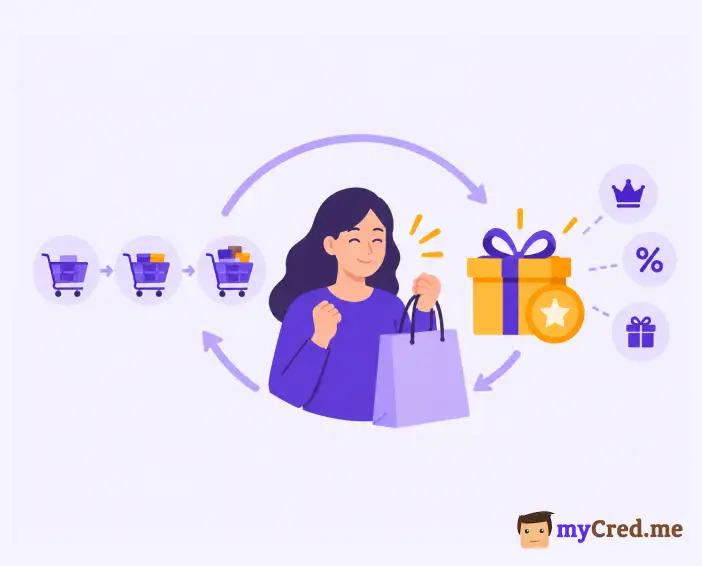
How to reward customers for repeat purchases comes down to one thing: give them a reason tied to their next order; not a vague thank-you for loyalty. Most loyalty programs reward the first purchase and stop there. That’s the gap.
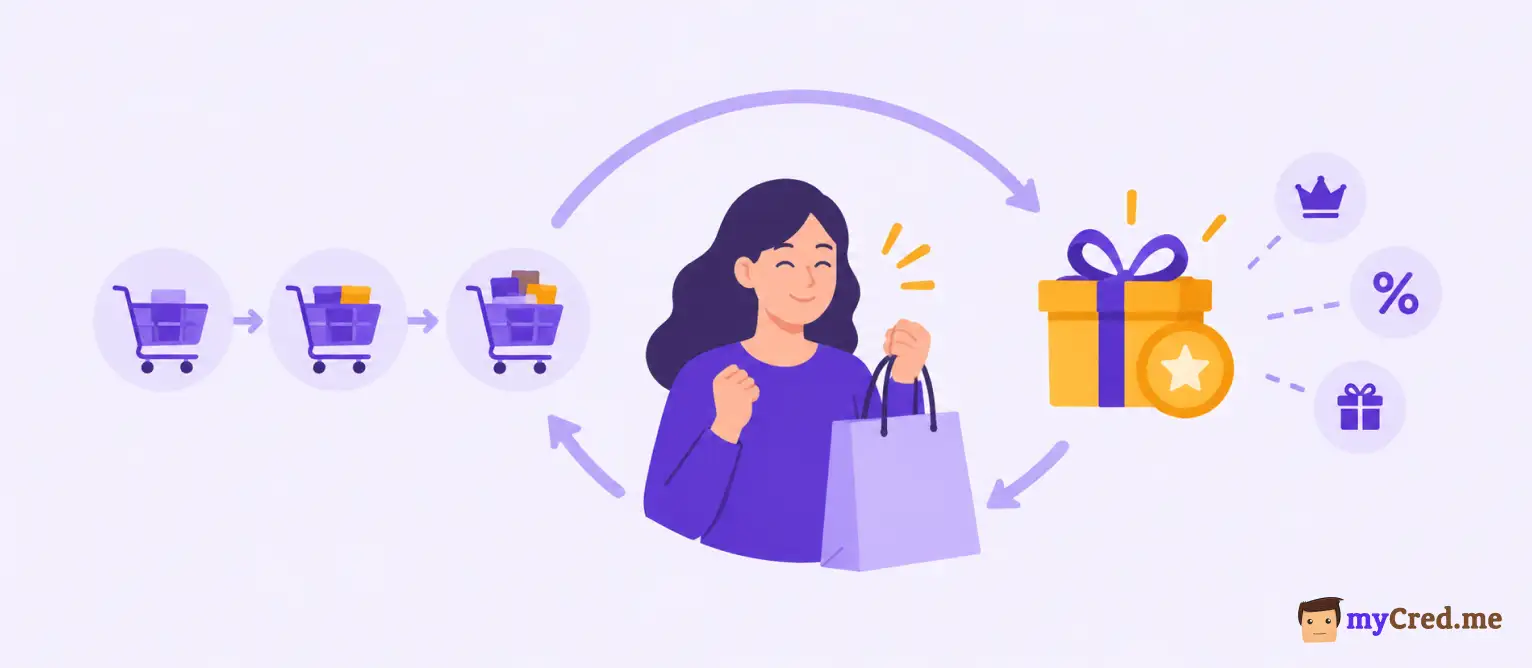
This guide covers second-purchase bonuses, milestones, VIP tiers, and win-back rewards you can set up to actually get that next order.
Why Repeat Purchases Matter
A customer’s second purchase is the most important one in the relationship. Once someone buys twice, a third purchase becomes 45% more likely.
A fourth becomes 54% more likely after that. The probability keeps climbing with every order (Sender, 2026).
This is why the goal isn’t “build loyalty” in some vague sense. It’s getting that next order to happen. Most stores don’t get there.
The average ecommerce repeat purchase rate sits at 28.2% (Sender; Opensend; DataAnalyticsStack, 2026).
That means roughly 7 out of 10 customers buy once and never come back. No reminder email, no second look, nothing.
- The ones who do come back are worth the effort. Repeat customers spend about 3x more per visit than first-time buyers (Sender, 2026).
- And the customers who actually redeem their loyalty rewards, not just sign up for them, show 5.3x higher repeat purchase rates and generate 115% more revenue per customer than non-members (Openloyalty, 2026).
A separate study puts it even sharper: redeemers hit a 50% repeat purchase rate, compared to 10.7% for people who never redeem (Rivo, 2026). That’s a 4.7x gap.
So the number that matters is redemptions. This also explains a shift happening across the industry right now.
Discount-based promotions made up 33.3% of promo spend in 2021. By 2026, that’s down to 11.1% (Openloyalty, 2026).
Brands are moving away from percentage-off coupons because discounts train people to wait for the next sale instead of buying on their own schedule.
The rest of this article sticks to loyalty reward types that don’t have that problem.
Rewarding the Second Purchase for a Loyalty Program
The second purchase deserves its own reward, separate from anything a customer already earned on their first order. Most programs skip this.
They reward the first purchase (a welcome bonus, a signup discount) and then go quiet until the customer hits some spend threshold. That gap is where you lose people.
A good second-purchase reward is small, guaranteed, and triggered by the order itself. Bonus points on order #2. A specific unlock tied to completing that second checkout.
Going back to the point above.
The industry has been pulling away from discount-based promos for years now, because they don’t build a habit. A guaranteed bonus tied to an order-count milestone does something a discount can’t.
It marks progress the customer already made, rather than just cutting a price.
How myCred Helps
If you’re running myCred, this maps to an order-count Hook. Instead of a generic “every order earns points” rule, you set a Hook that fires specifically when a customer’s order count hits 2.
It’s a small technical difference, but it changes the loyalty program reward from background noise into something the customer notices.
Rewarding Purchase Milestones
Milestones give customers something to work toward, not just something to look back on. A second-purchase reward gets someone past the first hurdle.
Milestones keep the streak going after that: 3rd order, 5th order, 10th order, whatever cadence fits your store.
A digital punch card, reward after X purchases, remains one of the most direct repeat-purchase drivers there is, because the goalpost is visible the whole time (Growave, 2026).
There’s a psychological reason this holds up: the endowed progress effect.
Once someone has made real progress toward a goal, they’re reluctant to walk away from it.
Loyalty research keeps circling back to this idea because it explains why customers protect points, ranks, and status they’ve already earned instead of starting over somewhere else (Openloyalty; LoyalNSave, 2026).
Milestones work best when the reward scales with the milestone. A small bonus at order 3. Something bigger at order 10.
If every milestone pays out the same amount, the later ones stop feeling like progress.
How myCred Helps
myCred has two features that map to this directly.
- Ranks handle the tiered version, moving a customer up a level after a set number of orders.
- Badges handle the one-time version, a “10th Order” badge that recognizes the moment without changing their ongoing tier.
Use Ranks for the cumulative structure and Badges for the specific milestone moments inside it.
Bonus Points for Frequent Buyers
Frequency rewards are different from milestone rewards. A milestone rewards a total count. Frequency rewards how often someone buys within a window, regardless of where they land on the overall count.
Loyal customers buy somewhere between 3 and 5 times a year on average, depending on the category (Opensend, 2026).
If a customer is already buying above that pace, that’s worth reinforcing directly. A points multiplier during a defined window (say double points for anyone who orders again within 30 days) rewards the habit itself instead of waiting for them to hit a cumulative number.
This matters because frequency and total spend aren’t the same thing.
- Someone who buys four small orders a year is building a habit.
- Someone who makes one large purchase and disappears isn’t, even if they’ve spent more.
If your reward structure only counts total spend, you’re missing the customers who are closest to becoming regulars.
How myCred Helps
In myCred, this is a multiplier Hook. You can apply it on top of standard point-earning rules or to a buyCred-based bonus-point event scoped to a purchase window.
The setup is the same idea as the second-purchase reward. Instead of one flat earning rate for everyone, you’re targeting a specific behavior pattern with its own bonus.
VIP Loyalty Tiers
Tiers work for the same reason milestones do: people protect status they’ve already earned. But tiers go further, because the reward isn’t just a one-time bonus. It’s ongoing access, better rates, or perks that only exist as long as the customer keeps their status.
The results back this up. Tiered programs have pushed repeat purchase rates up to 8.7x higher in top implementations (Rivo, 2026).
- Kitsch is a documented example: their VIP tiers generated $5.8M in loyalty-attributed revenue and delivered 73% higher average order value among tiered members (Rivo, 2026).
- Sephora’s Beauty Insider (45 million-plus members) and Nike Membership (160 million-plus active members) both show repeat engagement well above their industry averages using the same tiered structure (Openloyalty, 2026).
Tiers also change how customers respond to communication.
- 70% of consumers say they prefer engagement that’s targeted by their tier status, rather than a generic message sent to everyone (Rivo, 2026).
- And loyalty members overall show 28% higher retention and 18% higher average order value than non-members (DataAnalyticsStack, 2026).
One caution worth including here: tiers only work if there’s something to keep working toward.
A tier system with nothing new to unlock past the first level runs into the same problem. Build in room to keep climbing.
How myCred Helps
myCred handles the tier structure through Ranks, combined with Hooks that
- unlock tier-specific point rates
or
- rewards once a customer crosses a threshold
The Rank itself is the status. The Hook is what makes that status actually pay off.
Time-Limited Loyalty Rewards
A time-limited reward gives an existing customer a reason to buy again this week instead of sometime later. “Double points this weekend, for anyone who ordered in the last 60 days” turns a thinking customer into a buying one.
This is different from a normal sale.
A time-limited loyalty reward is scoped to people already in your program, and it uses something they’ve already built up, points balance, tier status, purchase history, as the trigger.
Scarcity works here for the same reason it works everywhere else.
Loyalty and gamification research points to time pressure as one of the more reliable levers for converting intent into action (Smile.io, 2025).
The same logic applies whether it’s a limited product drop or a limited reward window.
How myCred Helps
In myCred, you can build this by pairing the Expiration addon with a time-limited Hook.
Normally, Expiration is used to make points expire after a set period. Flip that around: use it to create a deadline that pushes customers to redeem or buy before their bonus window closes, and stack a Hook-triggered bonus on top of it during that window.
Personalized Loyalty Rewards
Customers who get a personalized experience are 60% more likely to become repeat buyers, and 64% say they’re willing to spend more with brands that tailor the experience to them (Rivo, 2026).
The same pattern shows up in email and win-back offers.
- Personalizing an offer based on someone’s actual purchase history lifts response rates by 20-40% (Propel, 2026).
- And offers built around product recommendations, instead of a flat discount, get 3.8-6.2x higher click rates than discount-only offers (Klaviyo 2025 Email Benchmarks, cited via US Tech Automations, 2026).
What this means in practice: don’t send “10% OFF everything” to your whole list. Send a reward tied to what someone already bought.
If a customer bought running shoes, the reward that gets them back is something related to running, not a blanket discount on the entire store.
How myCred Helps
myCred handles this by combining point-earning Hooks with WooCommerce order data.
Instead of one universal earning rule, you scope a Hook to fire based on what category or product a customer has already purchased.
That’s the actual mechanism behind “personalized,” not just a nicer subject line.
Birthday/Anniversary Rewards
A birthday or account-anniversary reward is small, and it should stay that way. It’s a low-cost way to remind a customer you know who they are.
But that’s still worth doing.
A personal touch like this builds a kind of trust that a discount code can’t, because it’s not tied to a transaction (Loyalty Gamification Guide, 2026).
Keep the structure simple: a fixed bonus point grant, or a small time-limited reward, tied to either their birthday or the date they joined your program. Nothing complicated.
How myCred Helps
In myCred, this runs off a Hook triggered by a stored customer date field, birthday or signup date, that grants points automatically when the date matches.
Re-engagement Loyalty Rewards
A re-engagement reward is the mirror image of the second-purchase reward. That one’s for customers just getting started. This one’s for customers who used to buy and stopped.
A customer is lapsed once they’ve gone about 1.5 to 2x their normal time between orders without buying again (Propel, 2026).
If someone usually orders every 30 days and it’s been 50, they’re lapsed. If someone usually orders every 90 days, that same 50-day gap means nothing.
- Win-back programs work, but not dramatically. A well-run one reactivates 3-10% of lapsed customers, and top performers hit 10-15% (Propel, 2026).
- More aggressive automated sequences report 12-18% (US Tech Automations, 2026).
Not every lapsed customer is worth the same offer. Segment by value before you send anything.
A high-LTV customer who’s gone quiet deserves a stronger, more specific offer than someone who bought once at a low price point (US Tech Automations, 2026).
How myCred Helps
myCred can flag inactivity using point-account activity or expiration data, then feed that into a win-back Hook that triggers a bonus. It’s the practical link between “you have points sitting unused” and an actual reason to come back and buy.
Example Repeat-Purchase Loyalty Reward Structure
Here’s how these pieces fit together in one program:
| Purchase Event | Reward Type | Trigger | myCred Mechanism |
|---|---|---|---|
| 1st purchase | Welcome bonus points | Order placed | Hook (order-based) |
| 2nd purchase | Guaranteed bonus (not %-off) | Order #2 completed | Order-count Hook |
| 3rd purchase | Milestone badge + bonus | Order #3 completed | Badge |
| 5th/10th purchase | Rank-up + reward unlock | Cumulative order count | Rank |
| Ongoing frequency | Points multiplier | Purchase within X days of last order | buyCred / multiplier Hook |
| VIP threshold | Tier upgrade | Spend or order-count threshold | Rank |
| 45-60 days inactive | Re-engagement point bonus | No order in X days | Expiration add-on + Hook |
| Enrollment/birthday | Small fixed bonus | Date match | Hook (date-triggered) |
If you’re starting from zero, build two things first:
- a second-purchase reward
- one milestone tier
That covers the highest-leverage moment (getting to order two) and gives customers something to work toward after that.
Add frequency bonuses, VIP tiers, and re-engagement once the basics are running and you can see which customers are actually redeeming.