


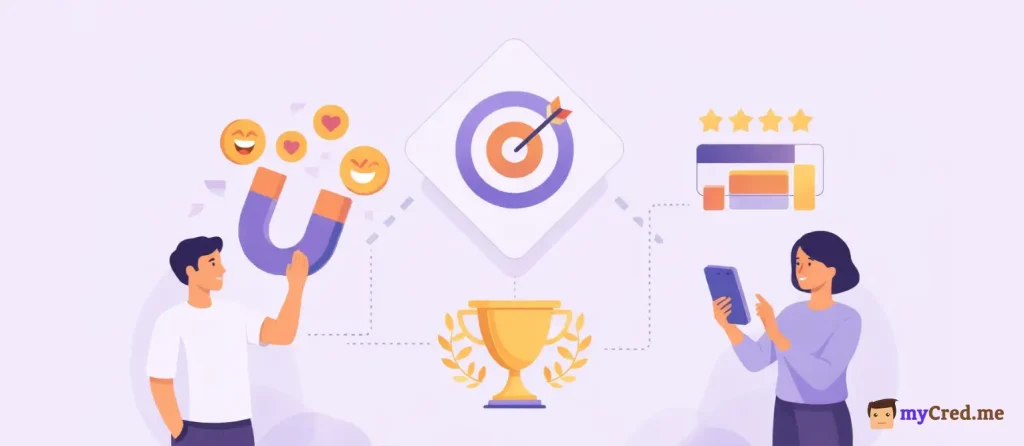
For businesses striving to scale, the Customer acquisition vs retention debate is a defining strategic decision. Do you invest to get new customers, or focus on retaining existing ones?
The answer is not an either‑or proposition; it’s both.
Acquisition is the driver of market growth, as you bring new people into your customer base through advertising, promotions, and free trials. On the other hand, retention is the engine of long-term profitability, converting first-time visitors into loyal customers who will spend more over time. Keep in mind that maintaining a balance between the two is crucial.
Acquisition costs are five to seven times higher than retention costs, according to HBR.
Further, the probability of selling to an existing customer is 60-70%, while the probability of selling to a new prospect is only 5-20%.
It is now more important than ever for businesses to use gamification to create a single strategy that not only acquires new users but also retains existing ones so that the business can benefit from their full potential.
Customer Acquisition vs Retention Dilemma (And How Gamification Solves It)
The core of the customer acquisition vs retention debate centers on the understanding of the roles and responsibilities associated with each. While customer acquisition is the process of bringing in new visitors and converting them into paying customers, customer retention is the process of keeping existing customers engaged and loyal to the brand.
Most businesses treat acquisition and retention as separate functions, leading to a fragmented customer experience. This is where gamification becomes the glue that removes demarcation of customer acquisition vs retention debate.
Gamification is defined as the use of game design elements and mechanics in non-game contexts to drive engagement. By embedding elements like points, badges, and levels into the customer journey, businesses can reward first-time customers with the same experience that converts them into long-term advocates.
Only a few intuitive platforms, like myCred, provide the toolset that helps websites build this cohesive strategy. By combining acquisition hooks with progression systems, every new customer becomes part of an ecosystem that is designed to maximize their lifetime value.
Customer Acquisition: The High-Cost Engine of Growth
The “growth-first” approach often drives customer acquisition. The sole purpose of this approach is to capture the maximum possible market share. This is achieved by focusing on high-volume, short-term tactics such as advertising campaigns, free trials, and promotional offers to generate immediate interest and convert prospects into first-time users.
The financial implications of this phase are reflected in the “Customer Acquisition Cost” (CAC). This metric measures the cost of acquiring new customers. These expenses include advertising, content creation, and the acquisition team. CAC is typically high because efforts must reach a broad audience to capture a small percentage of new users.
Despite the high costs, it remains essential because it is the only way to attract new customers to the business ecosystem. A healthy business often has a steady influx of new users to offset natural churn and support long-term growth.
The key to success is to ensure that not only is the acquisition investment sufficient, but the business also has a clear retention strategy. Without the potential to retain customers, the high cost of acquisition is never recouped; hence, the business is not sustainable.
Customer Retention: The Foundation of Sustainable Profitability
In a customer acquisition vs retention debate, client retention strategies shift the focus from a short-term to a long-term perspective. It is about building a brand experience so powerful that customers will stick with the business even when the competition offers better deals or more attractive marketing campaigns. This strategy is much more cost-effective because existing customers already know the brand’s value, require far less marketing spend to win over, and are much more receptive to new marketing offers.
The financial impact of customer retention can be measured by the “Customer Lifetime Value” (CLV), which estimates the total revenue a business expects to generate from a single customer over the lifetime of that relationship.
Loyal customers form the basis of CLV because they will continue to purchase products or services repeatedly, will be more forgiving of price, and will also act as a source of new customers by referring them to the business. This is evident in the reference article, which stated that existing customers are 50% more likely to try new products and spend 31% more than new customers.
However, effective retention is not passive; it requires a deliberate strategy. This involves creating a “loyalty progression model” that rewards customers for their loyalty. This could be through tiered loyalty programs, exclusive perks, or personalized experiences that make customers feel valued.
By investing in retention strategies and goals, a business can shift its focus from constantly seeking new customers to building on its existing customer base. This will not only reduce marketing costs but will also provide a predictable source of income.
Why Gamification Bridges the Gap Between Customer Acquisition vs Retention
Gamification is the key involving customer acquisition vs retention competition. It is defined as the use of game mechanics, such as points, ranks, badges, levels, and rewards, in non-game environments to drive user engagement and influence behaviors. When applied to the customer lifecycle, it is an extremely powerful tactic that lays down the structure of long-term engagement.
Why is it needed for acquisition? Generally, during the acquisition phase, customers are paying attention for only a very short time. Gamification can improve activation rates by providing an immediate incentive for customers to engage with your product, and even after they have completed their purchase. A reward for initial purchase, first-time visit, or even a visual progress bar towards earning the first badge can turn a one-time transaction into a journey.
Why is it needed for retention? After acquiring the customer, the next challenge is to retain them. Gamification helps design a loyalty progression model that gives customers a sense of accomplishment and a reason to return. This model moves beyond simple transactional rewards.
For example, a customer might start as a “Bronze” member, earning points for purchases and reviews. As they accumulate points, they progress to “Silver” and eventually “Gold,” unlocking exclusive perks and social status along the way.
This is based on psychological factors like the endowment effect, where customers are more likely to retain an object they own than acquire that same object; the loss aversion effect, where they perceive losses as more emotionally impactful than equivalent gains; and the Zeigarnik effect, where they want to finish what they have started. This way, the customer is engaged in their own loyalty progression model and is less likely to leave.
Customer Acquisition vs Retention: A Dual‑Phase Gamification Strategy with myCred
To effectively unify acquisition and retention, you need a powerful and flexible gamification engine that can leverage hooks for acquisition (registrations, referrals, daily visits) and add-ons for retention (ranks, badges, expiration, anniversaries) within a single points system.
The only loyalty-based point management system that meets the criteria is myCred. It is a powerful WordPress gamification and loyalty plugin that turns every customer interaction into a rewarding journey.
The plugin’s add-on system, along with loyalty program use cases, offers precise configuration and rewards (sign-up bonuses, referral rewards, daily engagement hooks, and tiered rank progression) throughout the customer lifecycle.
Acquisition Phase: Hooks Setup for Immediate Activation
The goal here is to create instant gratification and encourage the first critical actions.
- Registration Hook: Immediately award points within 60 seconds of signup. This can be configured under Points > Hooks > Registrations. A “Welcome Bonus” creates immediate positive reinforcement.
- Daily Visits Hook: Enable this hook to reward the first interaction. Configuring it for “Day 1” ensures the user is incentivized to return shortly after joining, reinforcing the habit of engagement.
- Referral Hook: Activate the “Points for Referrals” hook. This not only helps acquire new customers but also turns existing ones into advocates. Ensure the referral link is prominently displayed in the user’s “My Points” tab for easy access.
- Progress Bar Add-on: Install this add-on to provide visual feedback. Show a progress bar toward the user’s first badge or rank. This visual cue makes progress tangible and motivates the next step.
- Wheel of Fortune Add-on: This adds an element of chance and excitement. Configure it to offer variable reward entry points. The possibility of a “mystery bonus” creates a compelling reason to return early and often.
- Coupons Add-on: Create instant signup discount codes. Use the add-on to generate redeemable-for-points codes, seamlessly integrating the first purchase into the Gamification system.
Retention Phase: Long-term Engagement & Loyalty
With the user acquired, the focus shifts to building sustained value and preventing churn.
- Expiration Add-on: Enable point decay for inactivity. This creates a “maintenance requirement” that leverages loss aversion. A notification that “Your points expire in 30 days” is a powerful motivator to re-engage.
- Anniversary Hook: Use this hook to award annual loyalty bonuses. Marking the anniversary of a customer’s signup with a points reward acknowledges their long-term commitment and celebrates the retention milestone.
- Ranks Add-on (core add-on): Create a tiered progression system (e.g., Bronze, Silver, Gold). Set rank requirements based on minimum point balances or specific achievements. This provides a clear, long-term goal and confers status on loyal users.
- Badges Add-on (core add-on): Configure a collection of badges with sequential requirements. For example, a “Super Shopper” badge might be earned after 5 purchases, with a “Master Shopper” badge after 25. This “completeness anxiety” encourages continued engagement to finish the set.
- Loyalty Dashboard: A visual representation of their balance history, powered by myCred, reinforces the value they have built and the cost of leaving.
- Email Notifications: Configure loss-aversion triggers. Automated emails like “Your points expire in 3 days” or “You are only 50 points away from Gold status” are highly effective retention tools.
Critical myCred Specifics for a Balanced Strategy
To prevent abuse and ensure the system functions correctly, implement these critical configurations.
- Hook Limits: Set daily and weekly limits on acquisition hooks (e.g., daily visits, referrals). This prevents users from “gaming” the system to farm points, ensuring the Gamification economy remains stable and fair.
- Point Types: Create separate point types for different phases. For instance, use a “Welcome Bonus” point type for acquisition activities that have a shorter expiration, and a “Loyalty Points” type for retention activities that build long-term value.
- Transfer Add-on: Disable or restrict the “transfer add-on” during the acquisition phase. This prevents users from creating multiple accounts to farm points and consolidate them into a single account, a common form of Gamification fraud.
Customer Acquisition vs Retention: How to Track a Unified Gamification Strategy
To design a single gamification strategy, it is necessary to measure key performance indicators for both acquisition and retention. Here are the most commonly known metrics measured by experts.
Acquisition Metrics
- Customer Acquisition Cost (CAC): The cost of acquiring a new customer. Gamification helps reduce customer acquisition costs by improving the conversion rate through hooks such as a registration bonus.
- Activation Rate: The percentage of new users who complete a key first action, such as making the first purchase or achieving the first badge. This is the key metric for measuring the success of acquisition hooks.
- Daily Average User (DAU): The number of daily active users who use the business. A high DAU, driven by daily visits, indicates success with the acquisition hook.
Retention Metrics
- Monthly Average User (MAU): The number of users who use the business over the course of the month. The DAU-to-MAU ratio provides valuable insights into the business.
- Churn Rate: The percentage of the customer base that has stopped doing business with the organization over the course of the year. The design of the rank and badge system helps in reducing the churn rate.
- Customer Lifetime Value (CLV): The total revenue a business can expect from a single customer account. This is the key measure of success in the retention hook.
Loyalty & Engagement Metrics
- Net Promoter Score: A measure of customer loyalty and satisfaction. The NPS is calculated based on the likelihood that customers recommend the business to friends. The more engaged and ranked users would be more likely to be promoters.
- Redemption Rate: The percentage of points earned by the customer and redeemed. A high redemption rate indicates the customer has found the reward appealing and has been engaged in the Gamification system.
Customer Acquisition vs Retention: Real‑World Applications of Gamified Loyalty
Let’s consider a few scenarios in which a Gamification strategy is applied in real-world settings.
- An online learning platform. For acquisition, they use a myCred-powered “Registration Hook” to award points upon signup. This initial points boost allows new users to immediately unlock a free introductory course, significantly increasing the activation rate.
For retention, the platform implements a “Ranks Add-on”. Users progress from “Student” to “Scholar” to “Master” based on the number of courses completed and points earned. Each new rank unlocks exclusive content, such as live Q&A sessions with instructors. This creates a clear, long-term progression path that keeps users engaged for months, directly increasing their lifetime value.
- A fitness apparel e-commerce site. Their acquisition phase leverages the “Wheel of Fortune Add-On” on the homepage, offering first-time visitors a chance to win a discount code or bonus points on their first purchase. This surprise encourages immediate signup.
For retention, they use a “Badges Add-on” to create collection sets. A “Trailblazer” badge is earned for buying hiking gear, a “Marathoner” badge for running gear, and a “Yogi” badge for yoga apparel. Customers are motivated to build out their collection across different activities. Combined with the “Anniversary Hook,” which awards bonus points on the customer’s signup date. The brand builds a loyal community that consistently returns for new gear throughout its members’ fitness journeys. - A coffee shop chain. The coffee shop chain has a mobile ordering app. To acquire new customers, they have implemented a Referral Hook and a Coupons Add-on. This means that for every new customer referred to their coffee shop by a friend or existing customer, both parties will receive a free coffee as a welcome bonus. This encourages their loyal customers to bring in new customers.
For retaining customers, the coffee shop has implemented an Expiration Add-on. This means customers must make at least one purchase every 14 days to maintain their points. This encourages customers to make repeat purchases.
To encourage repeat customers, they have implemented a Ranks Add-on. This means that for every five customers they have bought coffee for, they will receive a free custom drink. For every 25 customers, they will receive a free drink created by their baristas.
For every 100 customers, they will receive a free drink of their choice. This encourages repeat customers to keep buying from their coffee shop.
- A local restaurant group with a loyalty app. They can attract more users to their app through its “Daily Visits Hook” feature, which offers a 7-day “Welcome Challenge.” New app users are rewarded with 50 points for checking in on Day 1, 100 points for checking in on Day 2, and 500 points for seven days of daily check-ins with its “Loyalty Starter” bonus. The app has become more attractive to users, as it makes them feel like they are starting a daily habit when they download it.
The app can retain its users through its “Badges Add-on” feature, which sets up goals based on how users like to eat, such as “Brunch Enthusiast” for three Sunday check-ins, “Dinner Diplomat” for five dinner reservations, and “Global Palate” for check-ins at three different types of cuisine.
The “Ranks Add-on” feature is also available, allowing users to achieve “Regular” status after 5 check-ins, “Favorite” status after 25 check-ins, and “VIP” status after 75 check-ins.
Common Customer Acquisition vs Retention Gamification Mistakes
Gamification fails not because the concept is flawed, but because execution is shallow. Most systems break due to poor incentive design, lack of constraints, or treating gamification as a short-term tactic instead of a long-term growth system.
Over-rewarding early users
To weigh in on customer acquisition vs retention, front-loading rewards destroys perceived value.
- Users collect easy points → no reason to stay
- Rewards feel cheap → engagement drops after initial spike
- High cost, low retention outcome
Fix:
Balance effort vs reward.
- Small instant rewards for activation
- Increasing difficulty for higher-value rewards
- Delay meaningful rewards to encourage repeat behavior
No expiration mechanics
Without loss, there is no urgency.
- Users stockpile points → no reason to return
- Engagement becomes passive
- Retention drops silently over time
Fix:
Introduce controlled decay.
- Time-based expiration (e.g., 30–60 days)
- Activity-based resets
- Reminder triggers (“Points expiring soon”)
No progression system
Flat systems fail. Humans need visible progress.
- No levels, ranks, or milestones → no long-term motivation
- Users disengage after first reward
- Loyalty never forms
Fix:
Build structured progression.
- Tiered levels (Bronze → Silver → Gold)
- Milestone rewards tied to behavior
- Visual progress indicators (bars, badges)
Ignoring abuse prevention
Uncontrolled systems get exploited fast.
- Fake accounts farming referral rewards
- Users gaming daily actions for points
- Inflation of reward economy
Fix:
Add constraints early.
- Daily/weekly limits on rewards
- Device/IP tracking for referrals
- Restricted point transfers
- Separate point types for acquisition vs loyalty
Treating gamification as a feature, not a system
This is the core failure.
- Adding badges or points without strategy
- No connection between acquisition, engagement, and retention
- Disconnected user experience
Fix:
Design a full lifecycle system.
- Acquisition → Activation → Engagement → Retention → Advocacy
- Each stage tied to specific mechanics and metrics
- Continuous optimization based on behavior data
Last Word on Customer Acquisition vs Retention
To conclude the customer acquisition vs retention debate, acquiring new customers and retaining existing ones shouldn’t be two different goals. Rather, they should be two ends of the same spectrum. Gamification is the answer to bringing these two ends together. Using a plugin like myCred is the answer to creating a vibrant and engaging experience. This is because myCred is feature-rich, offering many hooks, add-ons, and configuration options.
Therefore, to be successful, you have to gamify the entire experience from the first click to the 100th purchase.