



Cloudflare just entered the CMS war with EmDash, calling it a “spiritual successor” to WordPress. That is a bold claim. WordPress powers over 40% of the web, and no CMS has seriously threatened its dominance in years.
But EmDash is not another page builder. It is built for a different era. TypeScript, edge deployment, AI-native workflows.
So the real question is: Is EmDash actually a viable WordPress alternative, or just a developer experiment?
What is EmDash Cloudflare CMS?
Launched as v0.1.0 in early April 2026, EmDash is a serverless-first CMS. Unlike the traditional LAMP stack (Linux, Apache, MySQL, PHP) that powers WordPress, EmDash Cloudflare CMS is built on a modern distributed architecture.
What makes EmDash fundamentally different
This is not a traditional CMS with incremental upgrades. It is a full architectural reset.
1. Built for serverless and edge computing
- Runs on Cloudflare Workers and similar platforms
- “Scale to zero” architecture. No traffic = no compute cost
- Designed for modern distributed infrastructure, not shared hosting
2. Full-stack TypeScript, not PHP
- Everything from backend logic to frontend rendering uses TypeScript
- Strong typing improves developer workflows and reduces runtime errors
- Aligns with modern frameworks developers already use
3. Astro-based frontend system
- Themes are built as Astro projects (pages, components, layouts)
- Cleaner separation between content and presentation
- More flexible than traditional WordPress theming
4. Structured content (JSON, not HTML)
- Content stored as structured data, not markup
- Easier for APIs, apps, and AI agents to process
- Removes dependency on HTML parsing
5. AI-native architecture
- Built-in MCP server for AI agents
- CLI and “Agent Skills” allow programmatic site management
- Designed for workflows where AI actively builds and edits sites
6. Security-first plugin model
- Plugins run in isolated environments (Dynamic Workers)
- Each plugin must declare permissions explicitly
- Eliminates the “full access” risk common in WordPress plugins
Bottom line
EmDash is a masterpiece of engineering for developers who want a TypeScript ecosystem and MIT-licensed flexibility. However, it currently lacks the “one-click” simplicity that has made WordPress the home for 43% of the internet.
EmDash vs WordPress – What Are They Key Differences
The difference between EmDash vs WordPress comes down to architecture, security, and ecosystem maturity.
EmDash is modern, secure, and developer-focused. WordPress is flexible, mature, and built for mass adoption.
EmDash vs WordPress: Architecture and Tech Stack
- WordPress runs on PHP with MySQL. It follows a traditional LAMP stack that works on almost any hosting.
- EmDash is built with TypeScript, runs on Astro, and is designed for edge environments like Cloudflare Workers using SQLite/D1.
EmDash vs WordPress: Plugin Security Model
WordPress
- In 2025 alone, over 11,300 new vulnerabilities were discovered in the WordPress ecosystem; a 42% year-over-year increase. Critically, 91% of these threats originated from plugins rather than the WordPress core. This isn’t just bad luck; it’s a fundamental architectural flaw.
EmDash
- Capability-Based Permissions: Before you install a plugin, it must declare its manifest. If a “Newsletter” plugin asks for database: delete access, you can deny it. By default, it can only do what you explicitly allow (e.g., email: send).
- Hardware-Enforced Isolation: Leveraging Cloudflare’s Dynamic Workers, each plugin runs in its own V8 isolate. This creates a physical boundary in memory; if one plugin crashes or is compromised, it cannot “leak” into another plugin or touch the CMS core.
- Passkeys by Default: EmDash removes the #1 target for bots, i.e., the login page. By prioritizing Passkeys and Magic Links, it eliminates password-stuffing and brute-force attacks entirely.
EmDash vs WordPress: Ecosystem and Extensibility
- WordPress has over 60,000 plugins and a massive theme marketplace.
- EmDash is in early release. The ecosystem is extremely limited.
EmDash vs WordPress: Performance and Hosting
- WordPress performance depends heavily on hosting, caching, and optimization.
- EmDash is built for edge deployment, meaning content is served closer to users by default.
EmDash vs WordPress: Ease of Use
- WordPress is built for non-technical users. One-click installs, visual editors, massive documentation.
- EmDash requires developer involvement. Setup, customization, and deployment are not beginner-friendly.
EmDash vs WordPress: Hosting Flexibility and Control
- WordPress can run on any hosting provider, from cheap shared hosting to enterprise infrastructure.
- EmDash is optimized for Cloudflare’s ecosystem, especially Workers and D1.
Serverless vs. Traditional Hosting
The most significant operational difference is how these two systems live on the internet. WordPress is a persistent application; EmDash is ephemeral.
- WordPress (The Monolith): You pay for a server (PHP + MySQL) that runs 24/7, regardless of whether you have 1 or 1,000 visitors. When a traffic spike hits, your server can “choke” unless you have complex load-balancing or expensive Managed Hosting.
- EmDash (The Edge): Because it is built on Astro 6.0 and Cloudflare Workers, EmDash scales to zero. If nobody is on your site, you consume zero compute power. When traffic spikes, Cloudflare’s global network handles the load automatically across 330+ cities.
- Static-First Logic: EmDash treats content as structured JSON (Portable Text). This allows it to serve pages with near-zero latency, as the frontend is pre-rendered at the edge, while the admin UI remains a fast, React-based experience.
The Real-World Impact: For a developer or a small business, EmDash Cloudflare CMS offers enterprise-grade scaling for pennies. However, this performance comes with a trade-off: EmDash is “best” on Cloudflare. While it is MIT-licensed and can run on any Node.js server with SQLite, you lose the automatic sandboxing and edge-scaling that make it truly superior.
Is EmDash a Real WordPress Alternative?
EmDash is a WordPress alternative for developers and modern applications, but not a full replacement for most WordPress users due to its limited ecosystem, early-stage maturity, and higher technical barrier.
Where EmDash as a WordPress alternative actually works
Here are some useful use cases of EmDash:
1. Developer-first projects
If you are building with:
- TypeScript
- Modern frameworks
- API-driven architecture
Then EmDash CMS fits naturally into your workflow. It removes legacy constraints of PHP and traditional CMS structures.
2. High-security environments
- Sandboxed plugins
- Explicit permission control
- No shared execution layer
For teams worried about plugin vulnerabilities, EmDash vs WordPress is not even close here.
3. Edge-native applications
- Runs on Cloudflare Workers
- Content served globally at the edge
- Lower latency by default
If performance at scale matters, EmDash Cloudflare CMS review discussions consistently highlight this advantage.
WordPress vs. EmDash: 6 Reasons WordPress Still Dominates
While Cloudflare EmDash emphasizes speed and a lean architectural setup, WordPress remains the industry leader for scalable web infrastructure.
The following six reasons explain why WordPress continues to dominate for users prioritizing long-term resilience and functional depth.
1. Unlimited Customization and Modular Design
WordPress uses a standardized system of themes and block editors to enable granular brand alignment. Unlike the more rigid, code-heavy requirements of a lean edge-based setup, WordPress provides a visual and structural flexibility that accommodates emerging design trends without requiring a total rebuild.
2. A Comprehensive Plugin Ecosystem
The primary advantage of WordPress is its vast repository of native integrations. Whether a roadmap requires e-commerce capabilities, advanced forms, or membership portals, there are thousands of established plugins that allow for rapid deployment. This ecosystem enables businesses to add complex features in hours rather than weeks of custom development.
3. Data Sovereignty and Infrastructure Control
WordPress is self-hosted, granting users absolute ownership of their data and hosting environment. This eliminates the risk of vendor lock-in. You maintain the authority to migrate your entire site, database, and asset library to any server at any time, ensuring your digital assets are never tethered to a single proprietary platform.
4. Advanced SEO and Content Workflows
WordPress was built for content. It offers robust meta-controls, automated sitemaps, and sophisticated editorial workflows refined over two decades. While EmDash, as a WordPress alternative, requires manual logic for technical SEO, WordPress uses mature frameworks. That ensures schema markup and crawlability are handled systematically, reducing the margin for human error.
5. Global Community and Developer Support
The prevalence of WordPress has created a massive network of designers, developers, and consultants. This makes technical talent a commodity. If a site requires troubleshooting or a new feature, finding a qualified expert is straightforward, ensuring that your project is never stalled by a lack of specialized platform knowledge.
6. Proven Longevity and Support Roadmaps
Investing in a web platform is a long-term commitment. WordPress offers a transparent development roadmap with regular security updates and a history of backward compatibility. This established track record provides a level of stability and support that newer, edge-native solutions have yet to match, making it the more pragmatic choice for digital projects.
Where EmDash is NOT a viable WordPress alternative yet
1. Plugin-dependent websites
Most WordPress sites rely on:
- SEO plugins
- Page builders
- eCommerce tools
These do not exist in EmDash CMS at any meaningful scale yet.
2. Non-technical users
WordPress solves a core problem:
Anyone can launch a website without coding. EmDash breaks this model. It assumes developer involvement from day one.
3. Business-critical ecosystems
If your site depends on:
- WooCommerce
- Membership systems
- Loyalty or rewards tools
Switching to EmDash means rebuilding everything from scratch. That is a massive hidden cost most comparisons ignore.
The real problem most “EmDash vs WordPress” comparisons miss
People compare CMS features, which is the wrong lens. The real comparison is:
- WordPress = ecosystem + distribution + monetization tools
- EmDash = architecture + security + developer experience
Bottom line
If you are searching:
- “Is EmDash better than WordPress?” → Only in specific technical scenarios
- “Should I switch from WordPress to EmDash?” → Not unless you have a strong engineering reason
Right now, EmDash CMS is a niche alternative, not a mainstream WordPress alternative.
EmDash vs WordPress: The “Objective Reality” Comparison
| Aspect | WordPress | EmDash (Beta) | The Logic |
|---|---|---|---|
| Architecture | PHP + MySQL (Monolithic) | TypeScript + Astro (Edge) | EmDash is modern; WP is legacy. |
| Security | High risk (Unfiltered Plugins) | Sandboxed Isolates | EmDash is objectively safer. |
| Ecosystem | 60,000+ Plugins/Themes | Nascent (<100) | WordPress dominates utility. |
| Hosting | Anywhere (High Portability) | Cloudflare-optimized | EmDash has potential “Lock-in.” |
| Time to Revenue | Immediate (Pre-built tools) | High (Requires custom dev) | WordPress wins for business. |
What are EmDash Pros and Cons
The EmDash pros and cons come down to a clear tradeoff. You gain modern architecture, security, and performance. You lose ecosystem maturity, ease of use, and proven reliability at scale.
Pros of EmDash
1. Strong security architecture (biggest advantage)
- Sandboxed plugins using isolated execution
- Explicit permission model (least-privilege access)
- No shared runtime across plugins
Why this matters:
Most WordPress vulnerabilities come from plugins. EmDash directly eliminates this class of risk.
2. Modern developer experience (TypeScript-first)
- Full-stack TypeScript across backend and frontend
- Better tooling, type safety, and maintainability
- Works naturally with modern dev workflows
Insight:
For developers comparing EmDash vs WordPress, this is a major upgrade over PHP-based systems.
3. Edge-first performance by default
- Runs on Cloudflare Workers
- Global content delivery without extra configuration
- “Scale to zero” reduces infrastructure overhead
Result:
Fast performance out of the box, without caching plugins or CDNs.
4. Structured content system (future-proof)
- Content stored as JSON, not HTML
- Easier integration with APIs and apps
- Better suited for headless and AI-driven use cases
Insight:
This aligns with how modern applications consume content.
5. Built-in AI and automation capabilities
- Supports AI agents via MCP server
- CLI-based workflows for automation
- Designed for programmatic content management
Reality:
This is forward-looking, but still early in practical usage.
Cons of EmDash CMS
1. Extremely limited ecosystem
- No large plugin marketplace
- Very few themes or integrations
- Missing critical tools (SEO, eCommerce, marketing)
Impact:
This alone prevents EmDash from being a true WordPress alternative today.
2. High technical barrier
- Requires developer setup and deployment
- No simple “install and go” experience
- Not suitable for beginners or small businesses
Comparison:
WordPress wins easily on accessibility.
3. Platform dependency concerns
- Optimized heavily for Cloudflare infrastructure
- Best performance tied to Workers and D1
Risk:
Potential vendor lock-in. Less flexibility than self-hosted WordPress.
4. Unproven at scale
- Early-stage product (v0.x)
- Limited real-world production use cases
- Unknown long-term stability
Insight:
This is not just a feature gap. It is a maturity gap.
5. Missing business-critical features
- No WooCommerce equivalent
- No mature membership systems
- No loyalty or rewards infrastructure
Reality:
For most businesses, this is a dealbreaker.
Final insight:
EmDash CMS is technically impressive, but practically incomplete.
That is why most “EmDash CMS review” discussions reach the same conclusion. It is promising, but not ready to replace WordPress for real-world business use.
Why WordPress Still Dominates
In the “War of the CMSs,” architecture is only half the battle. The other half is utility.
As of April 2026, the contrast between these two platforms couldn’t be sharper: WordPress is a thriving metropolis; EmDash is a high-tech research outpost.
The primary reason WordPress remains unbeatable for business is its network effect. With over 60,000 plugins and a two-decade head start, WordPress isn’t just a tool; it’s an entire economy of developers, agencies, and pre-built solutions.
- The Plugin Desert: EmDash currently has a marketplace architecture but effectively zero community plugins. If you need an advanced SEO suite, a complex form builder, or an LMS, you have to build it yourself in TypeScript.
- Non-Technical Accessibility: WordPress’s Site Editor and block ecosystem allow marketing teams to launch professional pages without touching a line of code. EmDash themes are Astro projects that are powerful and flexible, but they require a developer for even basic layout changes.
- The Training Gap: Almost every digital marketer on the planet knows how to navigate the WordPress dashboard. Switching to EmDash requires retraining your entire physical or remote team on a new mental model of “structured content” and JSON-based workflows.
The Verdict: EmDash is what a CMS looks like when it’s designed for AI agents and senior engineers. WordPress is what a CMS looks like when it’s designed for people.
EmDash vs WordPress and The myCred Factor
To describe “Ecosystem Gap,” we have perfect examples in gamification and user retention. For a modern business, a website is an engagement engine.
If you want to build a loyalty program on EmDash, you face a massive hurdle. You would need to architect a custom database schema in Cloudflare D1, write secure TypeScript logic for point triggers, and build a front-end UI for badges and leaderboards from scratch.
On WordPress, you install myCred.
- Instant Functionality: Within minutes, you have a battle-tested points management system that handles rewards, ranks, and badges out of the box.
- Deep Integrations: myCred doesn’t live in a silo; it connects natively to WooCommerce, LearnDash, and BuddyBoss. It leverages the existing WordPress infrastructure to turn visitors into loyal customers instantly.
- Proven ROI: While EmDash offers “cleaner code,” myCred offers revenue-driving features that are already mature, secure, and supported by a massive community.
Technology alone does not win CMS wars. Ecosystems do. Tools like myCred show what ecosystem depth actually looks like.
Why this matters for decision-making
If you are evaluating EmDash vs WordPress, the real question is not:
“Which CMS is technically better?”
It is:
“Which CMS helps me generate and retain revenue faster?”
With WordPress:
- You install a plugin like myCred
- You activate a full loyalty and rewards system in hours
With EmDash:
- You need to build these systems yourself
- Or wait for the ecosystem to catch up
Insight
Even if EmDash CMS is technically superior in some areas:
- It lacks monetization infrastructure
- It lacks retention tooling
- It lacks ready-to-use business systems
The “Spiritual Successor” Debate
Calling EmDash a WordPress successor is a positioning strategy, not a market reality. It reflects technical ambition, not ecosystem readiness.
Cloudflare’s Position
Cloudflare is framing EmDash CMS as a reset of what a CMS should be. Cloudflare is not competing with WordPress on features. It is challenging the foundation WordPress was built on.
This is where the EmDash vs WordPress narrative breaks down.
WordPress core value
- Accessibility for non-technical users
- Open ecosystem with no platform dependency
- Ability to run anywhere, at any cost level
EmDash tradeoff
- Optimized for Cloudflare infrastructure
- Higher technical barrier
- Potential platform dependency
Major WordPress Voices on EmDash
The launch of EmDash has triggered a wave of commentary from the ecosystem’s most prominent figures. Their collective stance? Technical brilliance is one thing, but unseating a global standard is another.
- Tom Zuar (Kinsta): Zuar views EmDash through the lens of history, noting that the “WordPress Killer” trope is a recurring cycle that usually ends in a stalemate. His stance is that betting against the sheer scale of the WordPress ecosystem is a statistical error, predicting that the platform will remain the dominant force for decades regardless of new technical challengers.

- Matt Mullenweg (WordPress Co-founder): Mullenweg has been the most vocal critic of the “spiritual successor” label. While he has praised the engineering behind the V8 isolation and the move to TypeScript, his primary critique is that EmDash feels like a proprietary gateway disguised as open source, optimized primarily to sell Cloudflare services rather than empowering users to run their sites on any $5-a-month host.

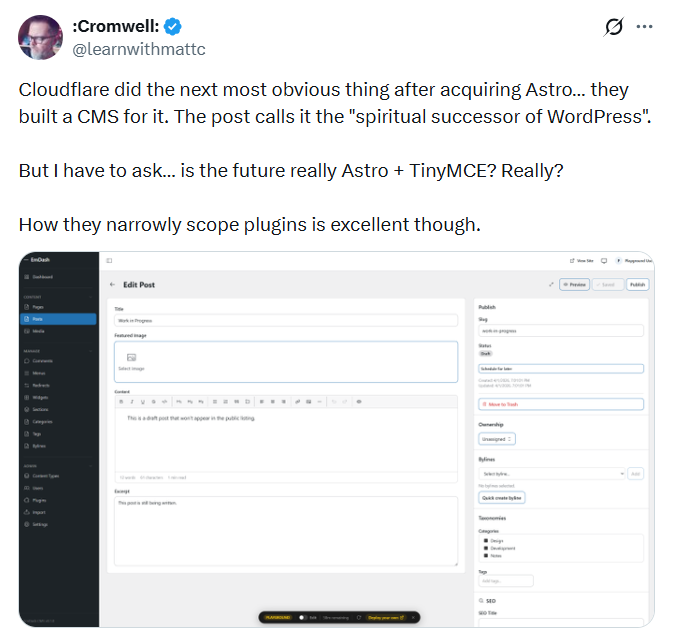
- Matt Cromwell (GiveWP): Cromwell highlights the strategic logic behind the launch, viewing it as the inevitable evolution of Cloudflare’s Astro acquisition. While he praised the tightly scoped plugin architecture as an engineering win, he questioned the “spiritual successor” marketing, specifically doubting whether a stack reliant on Astro and TinyMCE truly represents the next frontier of web publishing.
- Syed Balkhi (WPBeginner): Balkhi’s critique focuses on distribution and decentralization. He argues that as long as EmDash remains tied to Cloudflare’s proprietary infrastructure, major hosting providers like GoDaddy or Hostinger have no incentive to support it. Without one-click installations across the broader web, EmDash risks remaining a “walled garden” project.

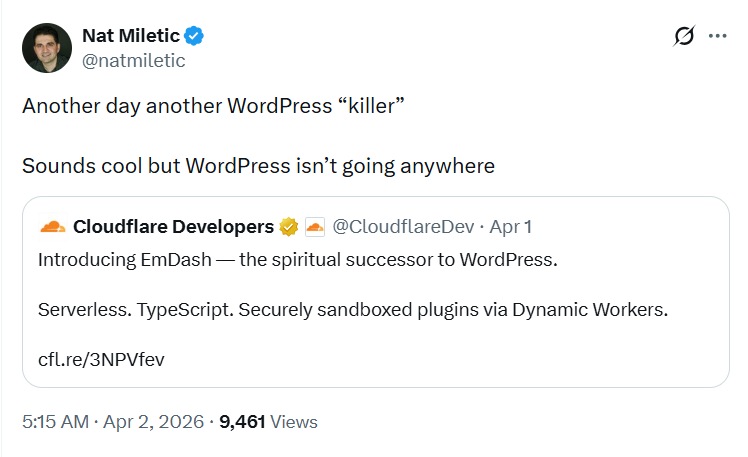
- Nat Miletic: Miletic dismissed the hype as another cycle of “killer” branding, reinforcing the idea that while EmDash may be “cool” from a technical perspective, it lacks the market gravity required to displace the current leader.
The Verdict by Top WordPress Voices
The consensus is clear: The WordPress elite are impressed by the V8 sandboxing and modern DX, but they are fundamentally skeptical of the vendor lock-in and the lack of a proven marketplace.
For a business-critical tool like myCred, the stability of the WordPress environment remains its greatest competitive advantage against these “experimental” alternatives.
Last Word
EmDash vs WordPress comes down to tradeoffs, not a clear winner. The arrival of EmDash is the wake-up call the WordPress community needed. While it may not be a “Spiritual Successor of WordPress”, it is a formidable technical benchmark. By proving that a sandboxed plugin model and TypeScript-native architecture are possible, Cloudflare has set a new standard for performance and security.
Healthy competition is a win for everyone. However, for those building revenue-focused websites in 2026, the choice remains clear: You do not abandon a functional city for a high-tech blueprint. On one side, you have the promise of a “cleaner” codebase; on the other, you have the immediate, tangible power of tools like myCred to drive user engagement, loyalty, and actual profit.
Are you tempted by EmDash, or are you doubling down on WordPress + myCred for your loyalty and engagement needs?