



Gamification is the process of incorporating game design elements into non-game contexts, such as education. By using techniques such as points, badges, ranks, and leaderboards, teachers can increase student engagement and motivation in the classroom. One way to do this is by incorporating Game Based Learning (GBL) into your Learning Management System (LMS).
So if you are running a WordPress-based Learning Management System (LMS), then by using myCred (a top-rated WordPress gamification plugin). You can easily integrate personalized gamification into the LMS to make it more engaging for your students.
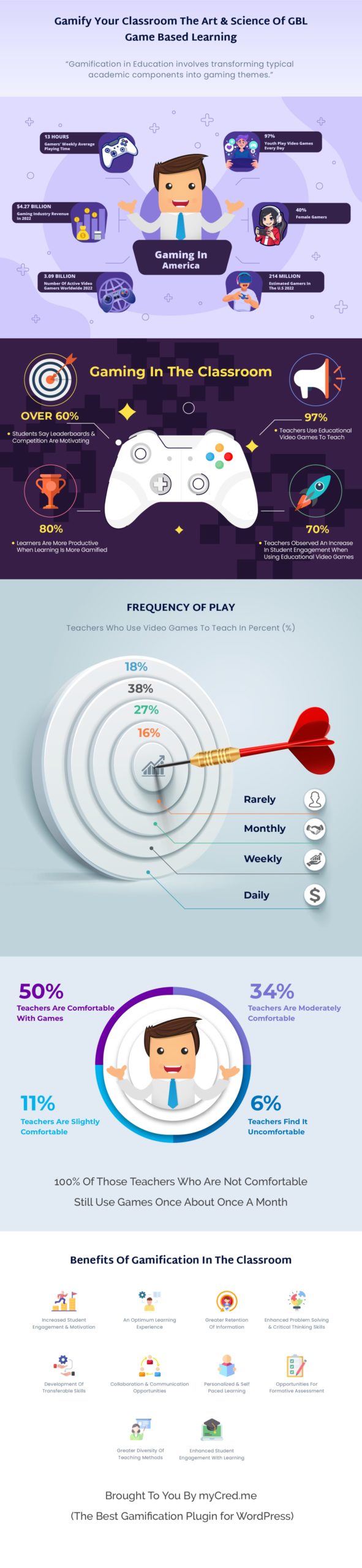
You can check out the following infographic to learn some interesting facts and statistics about the benefits of game based learning and how you can implement it for better learning.
Wrapping Up
Incorporating Game Based Learning in Learning Management System (LMS) can effectively enhance student engagement and motivation during class, thus improving students’ performance, learning outcomes, problem-solving skills, and much more.
So, don’t let your LMS fall behind; visit www.mycred.me and start using myCred (a top-rated WordPress gamification plugin) to supercharge your LMS for better learning today!